Should you hire creators or run ads for your subscription app?
TL;DR:
Paid ads still lead subscription app growth. Even apps with dedicated influencer teams drive most installs through paid.
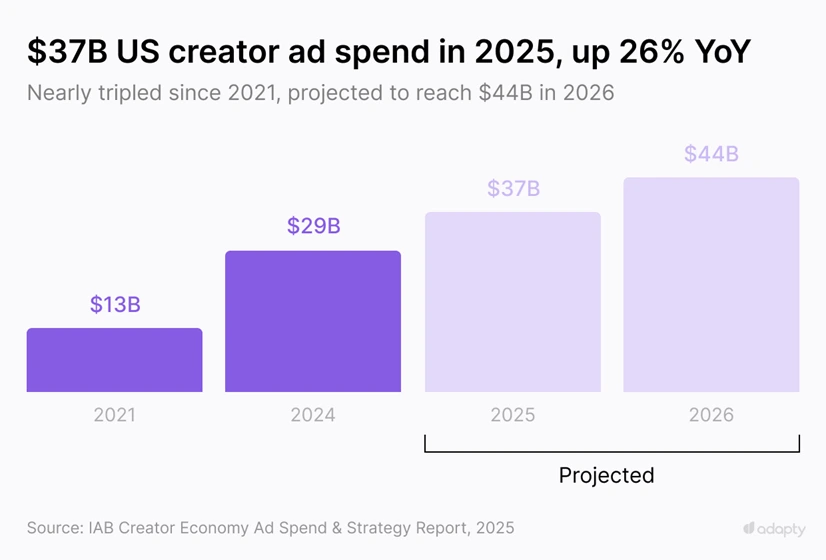
Creator/UGC is rising fast though, and it's mostly American. US creator ad spend nearly tripled to a projected $37B (IAB); organic runs ~37x more views in the US than the EU.
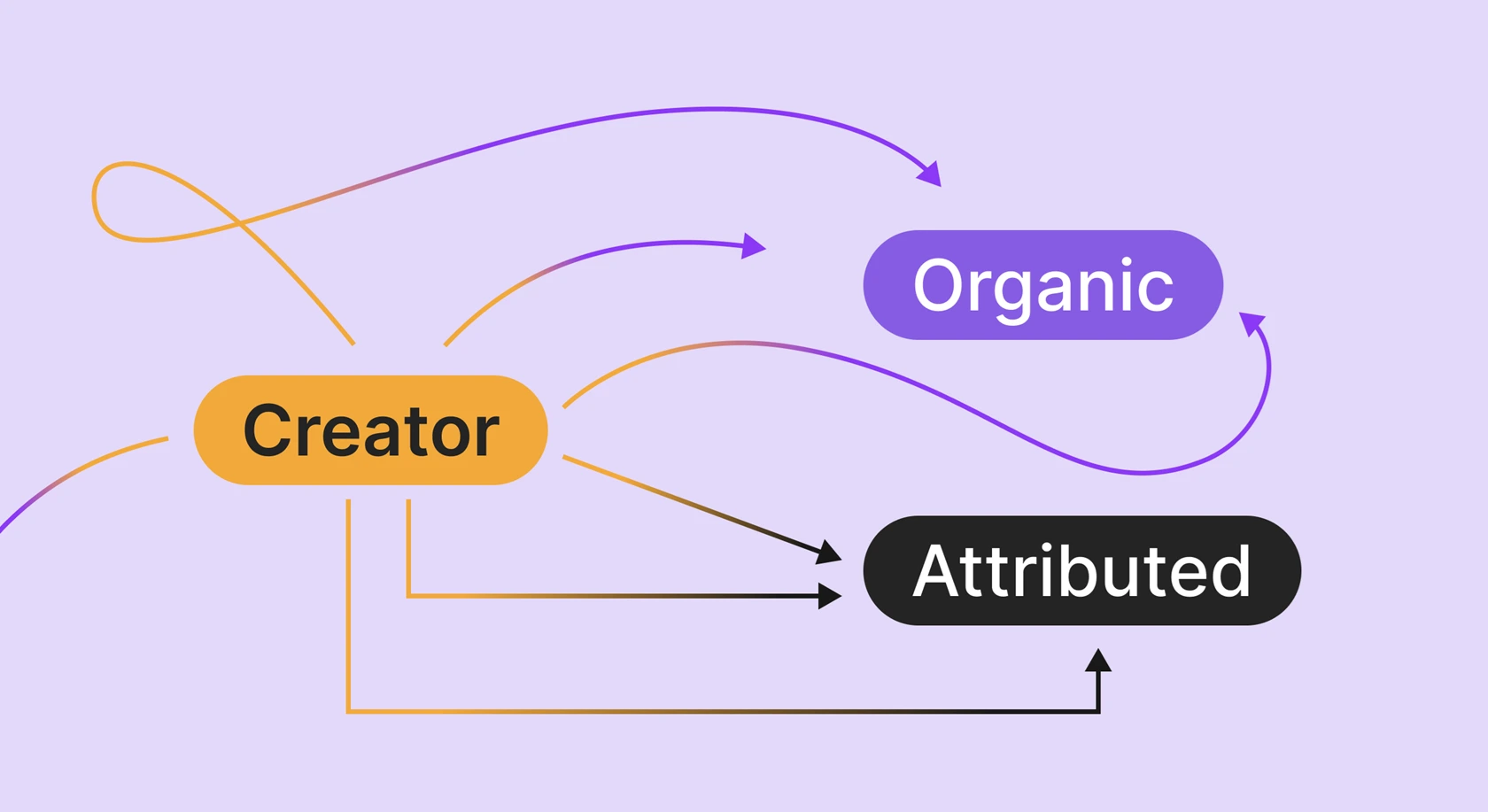
The winners converge the two: creator content becomes your best paid creative, measured on subscription revenue, since organic installs can't be attributed.
One of the good things about being in constant contact with app developers worldwide is that you spot an emerging trend in one market before it spills over to the next.
Recently we noticed a pattern just like that, especially among our US clients.
Some of them told us they're pouring money into content creators. Not just influencers in the traditional sense, but micro creators with viral potential.
Some of these apps even run dedicated teams for it. We know, since we work with them.
Naturally, that raised questions worth answering with data:
Is this a trend endemic to the US? Maybe a confirmation bias with no basis in reality? Or does creator marketing have the potential to topple the paid ads hegemony?
The only way to find out is to pull our own data and reach out to experts. What we found should help you place your next acquisition bet.
This article was possible thanks to data from Social Growth Engineers, a creator-marketing agency that has tracked organic TikTok and Reels campaigns across 1,800+ consumer apps since 2024. Their team specializes in the creator/UGC playbook covered here: sourcing micro-creators, building multi-account networks, and scaling short-form content for app growth.
What is creator content for apps and why is it exploding right now?
First off, a distinction that most coverage misses:
- Influencer marketing rents an audience: you pay someone with a large following to mention your app.
- Creator/UGC marketing builds reach from zero: a company hires smaller creators to post from fresh accounts, and the algorithm, not the follower count, decides who sees it.
And while influencer marketing has already settled, creator marketing is just starting.
Its emergence is tied to TikTok’s emergence. The platform’s feed ranks each video on its own merits, so a first-ever post can outperform an account with a million followers.
That one design choice created a labor market. Students and micro-creators now get paid to produce app content without building an audience first, and UGC agencies exist to supply them.
Here’s one example of a creator promoting an app:
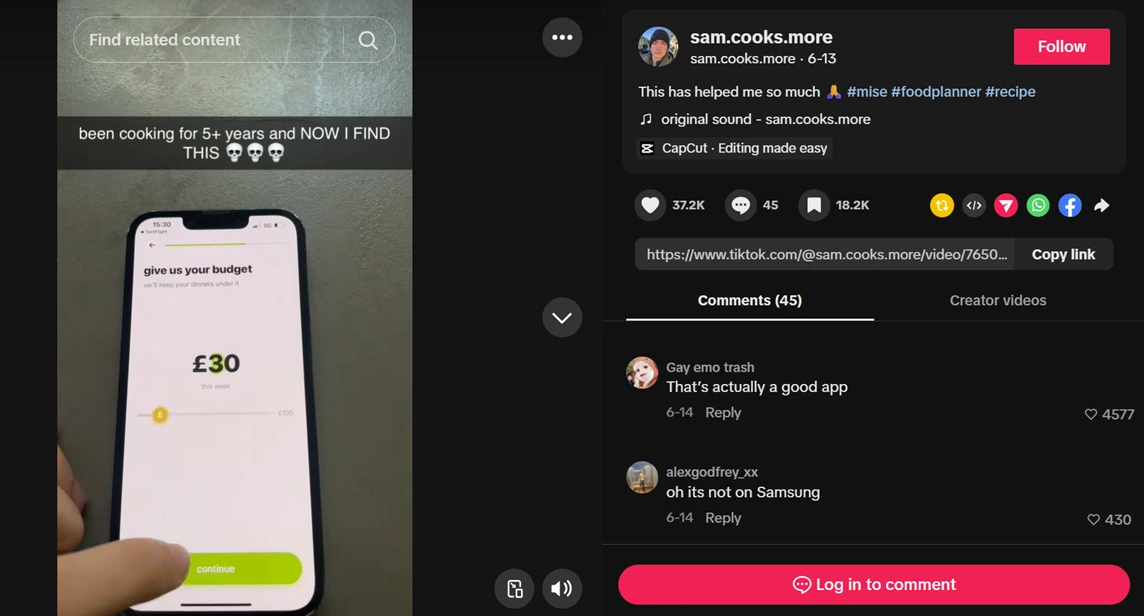
You can see the discrepancy in views between that one clip that went viral (735K views) and the rest. You're betting on these creators to hit the algorithm jackpot.
But many are willing to bet. Per IAB, US creator ad spend grew from $13.9B in 2021 to $29.5B in 2024, hit a projected $37B in 2025, and should reach $44B in 2026.
Almost half of ad buyers now call creators a "must buy," ranking the channel just behind paid search and social.
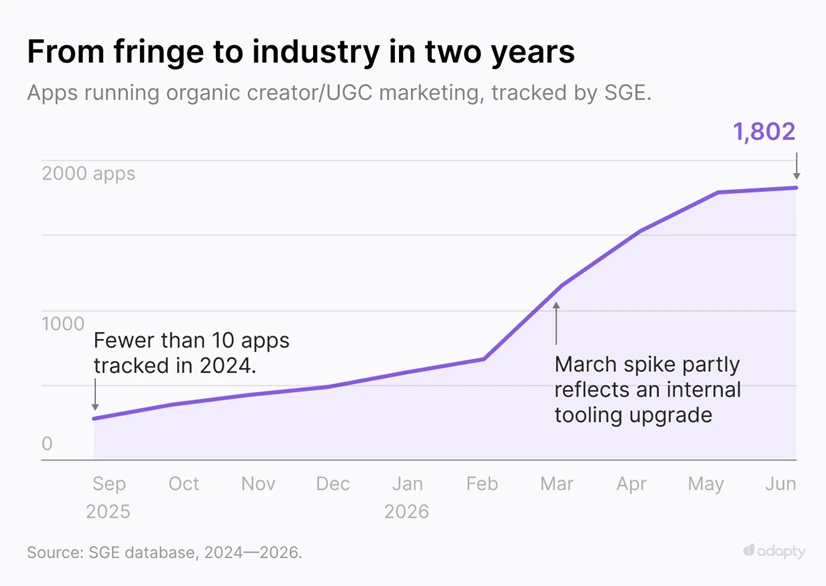
The app-specific framework grew even faster.
Marketing researchers at Social Growth Engineers (SGE) tracked fewer than 10 apps running organic creator marketing in 2024. Today its database covers 1,800+.
According to SGE, the structure of the creator framework goes like this:
- 3–4 fresh TikTok accounts per market. One to three posts per day, per account.
- Every video cross-posted to Reels.
- Winning teams scale to dozens or hundreds of accounts.
Is creator marketing for mobile apps really a US phenomenon?
The numbers say so, but with a caveat.
Of the 1,800+ apps and businesses in SGE's database, 1,460+ are US-based. Nearly 200 come from the EU, and the remaining ~150 from the GCC, Australia, South America, Asia, and Africa.
Roughly four out of five apps running the organic creator playbook are American.
Our data aligns. In our internal survey, every app that had run a deep creator program (a dedicated influencer team, a months-long creator push, an earned-organic engine) named the US as its main market.
The European respondents ran paid almost exclusively; where creators appeared at all, it was "a secondary source" or "planned for next quarter."
It’s a small sample, so take it with a grain of salt. But that last answer is worth sitting with: the spillover to Europe has already started.
Views tell the same story at a larger scale.
In 2026 so far, US-targeted English content in SGE's tracking generated 1.294 billion organic views. Content in EU languages targeting EU markets generated 35.2 million. That is a ~37x gap.
Before you object: yes, part of that gap is simply more US apps in the database.
Adjust for app count and the gap shrinks but doesn’t close. US apps pull roughly five times the views per app, which is what a single 330-million-person English market does for you.
⚠️Don’t treat numbers as gospel. SGE tracks apps that already run organic creator marketing, and SGE's own client base skews American. Their data confirms the direction of the skew, not its exact size.
Why did creator marketing grow for US and not European apps?
The lazy answer says US apps are richer.
Here, our data disagrees: European apps price higher than North American ones (median annual price $40.63 vs $36.39) and monetize at comparable levels.
Money is not the reason, but three structural conditions are.
The US got a head start
TikTok went mainstream in America first, and the playbook developed there.
The platform's algorithm meant a first-ever post could outperform a million-follower account, and US teams were the first to industrialize that insight: fresh accounts, daily posting, creators hired straight from universities.
Creator marketing was almost 100% US-based until very recently.
By the time European apps started paying attention, US teams had been running the creator ops for two to three years.
One language, one giant market
A single English video can reach ~330 million people.
In Europe, you have to either rebuild the entire campaign depending on the language, or localize it.
One app, known for being one of the most ambitious European operators, runs 240 tracked accounts across 15+ regions in 11+ languages, and still fights Spanish content leaking onto German accounts.
Another runs 344 accounts across 9 languages and now competes with seven lookalike fan accounts in France alone. That’s the creator marketing reality in Europe.
Creator supply is deeper in the US
American teams recruit from a large, normalized pool: students, UGC agencies, creators poached from rival apps.
Europe has the talent, but scattered across smaller per-market pools, so recruiting costs more time and money in every country.
ℹ️European apps can still do this. One European EdTech app built local creator networks per country instead of translating one campaign: 100+ accounts, 360M+ organic views, ~1.5M monthly downloads, and a top-15 Education ranking in 10+ countries. It’s harder, but it isn’t impossible.
Is creator marketing taking over user acquisition?
No. “Takeover” is a strong word. And we say that after we surveyed app acquisition teams ourselves.
We asked subscription apps that we work with—both US and European markets—what actually drives their acquisition.
Almost every answer came back paid-first: Meta, Google, TikTok Ads, and Apple Ads doing the heavy lifting.
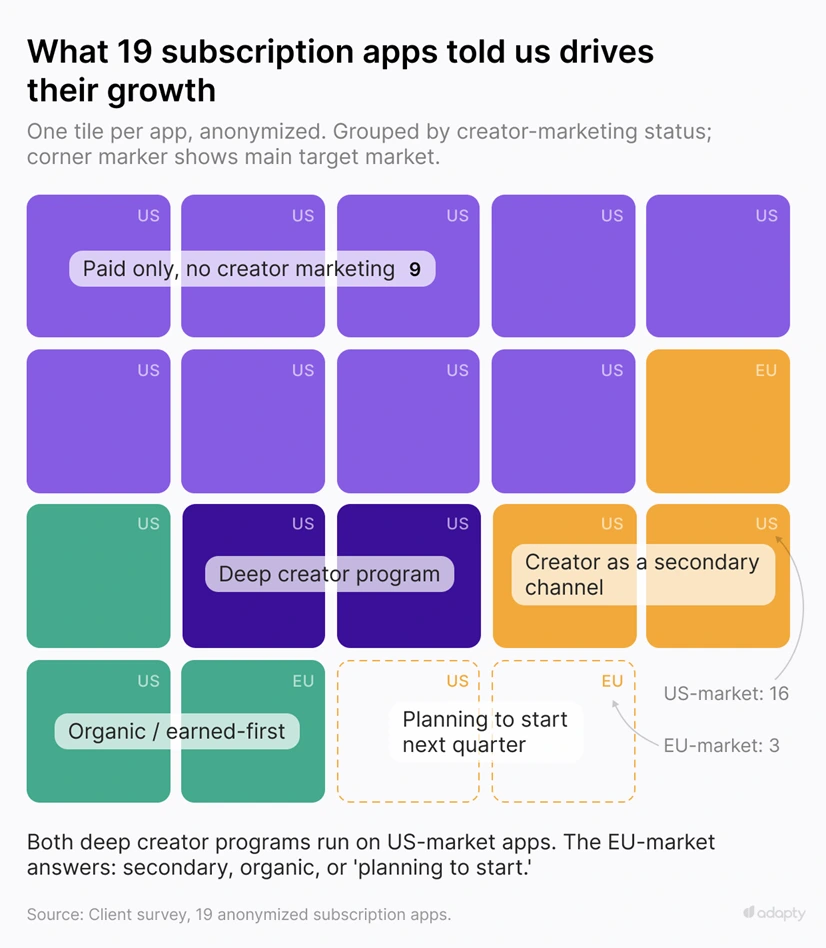
A few use creators as a second or third channel. Some had paused creator programs. Several had never run one, but plan to. Paid channels still dominate.
One app with a dedicated in-house influencer team showed 97% of acquisition from paid ads and 3% from creators in its own analytics.
Creator marketing is growing in the US, but it’s still a minority playbook even there. Paid acquisition remains the backbone on both continents.
Despite its viral potential and novelty, creator marketing carries a risk many acquisition teams won't take: it's nearly impossible to attribute.
Why can't you measure creator marketing like paid ads?
Because the data does not exist, and we can prove it with our own data.
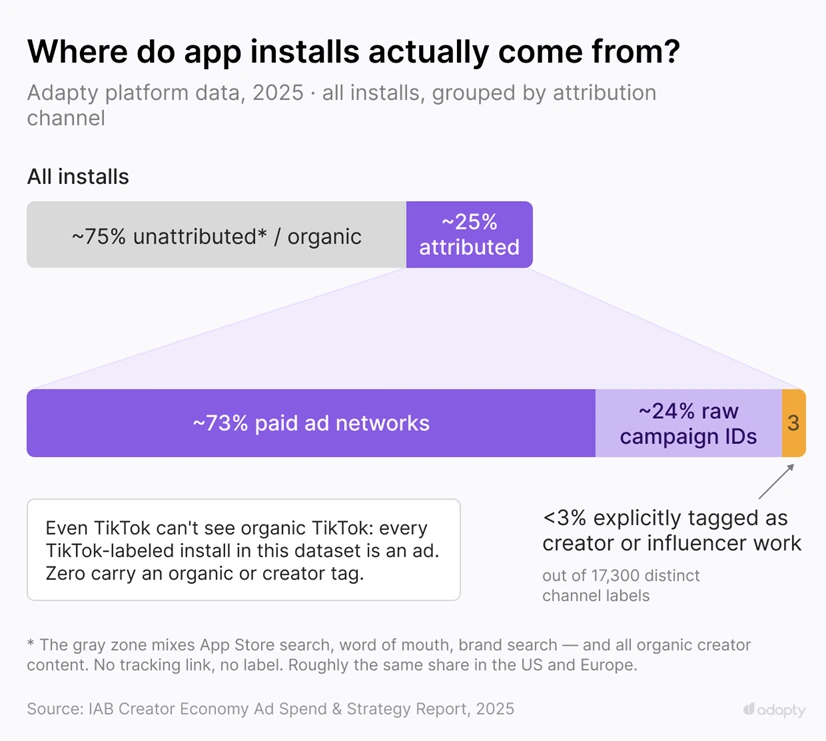
We pulled our 2025 install data, grouped by attribution channel, hoping to isolate creator-driven installs. Around 75% of all installs sit in the organic/unattributed bucket, in the US and Europe alike.
The attributed remainder splits across thousands of distinct channel labels. Content explicitly tagged as creator or influencer work makes up under 3% of attributed volume.
TikTok-labeled installs in our dataset are 100% ads. Zero percent carry an organic or creator tag. So even TikTok cannot see organic TikTok.
An organic post has no tracking link, so its installs dissolve into the same bucket as App Store search and word of mouth. No MMP fixes this. The blindness is structural.
The industry knows. In IAB's own study, buyers named better attribution and tools linking creator work to business outcomes as their top asks from the ecosystem.
So what do teams optimize instead?
Views, mostly. SGE told us that for clients running paid alongside organic, "success is usually measured through views."
Sophisticated apps refuse that bar and hold every channel to revenue metrics instead.
That split in measurement maturity decides who profits from this channel.
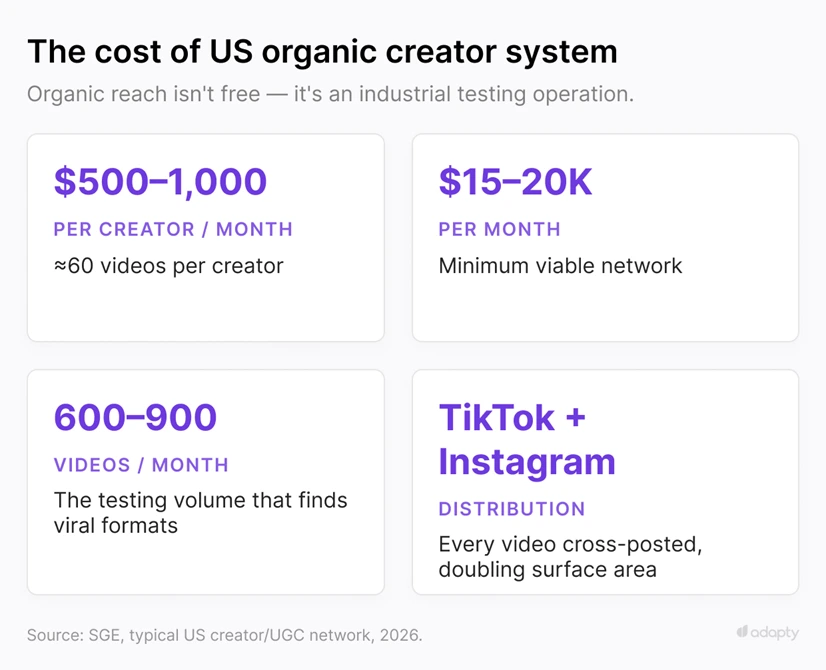
Creators aren’t free, though. A minimum viable creator network runs $15–20K per month for 600–900 videos, at $500–1,000 per creator. Budget it like a real channel, because it is one.
Creators or paid ads: which is the smart move?
After reading this, you’re probably thinking about sticking to paid channels.
But the real answer might be that this isn’t an “either-or” choice.
The creator trend is warming up and with creator tools getting more intuitive and algorithms getting more creator-centric, the trend could stick around.
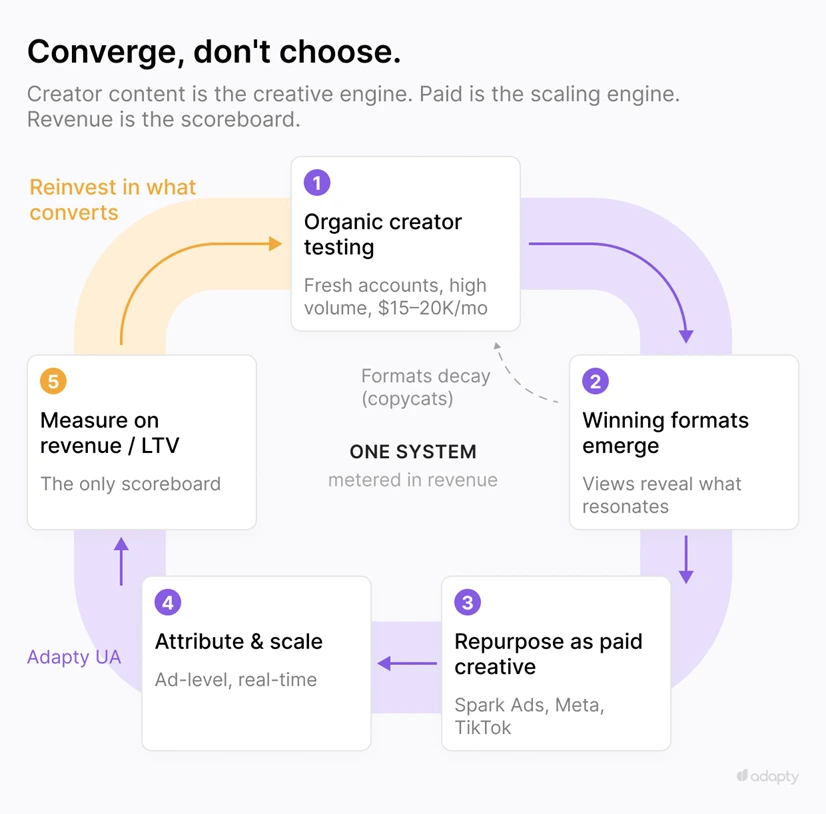
The apps winning right now run both creator marketing and paid acquisition as one system.
The clearest story came from one of our clients that ran creator marketing hard for months. Their verdict, in their own words:
"Early on it worked really well on two fronts: strong organic views and reach, and the creator content doubled as our best paid-ad creative. Honestly that second part, creative fuel for paid, was the bigger win for us. [...] We don't judge it on views, we hold it to the same downstream bar as paid." - A Religion app.
They repurposed their learnings from organic creator content to fuel their highest-performing Meta and TikTok ad creative.
SGE sees the same pattern from the supply side.
Their clients' best organic videos get reused in paid campaigns; one client, a major women's health app, generated over 2 billion ad views on top of organic creator videos.
The wider market shows that it’s moving the same way.
AppsFlyer's Performance Index now ranks ad networks on UGC creative performance, and eMarketer and Magna forecast mobile video ad spend passing search for the first time in 2026, driven by short-form reallocation (source).
What should your creator marketing playbook look like?
Use the organic network as a cheap, high-volume format lab.
Take the proven winners into TikTok and Meta ads, where creative testing has real attribution.
Expect formats to decay when copycats arrive, and keep the lab running so the pipeline never depends on one viral hit. Score the whole system in revenue.
How do you measure a half-invisible funnel?
Split it at the line attribution can see.
The organic layer. Stop chasing install attribution; nobody has it, including TikTok. Judge organic creators’ work by cohort revenue and LTV movement in the periods and markets where the network runs, the way you would judge brand spend.
The paid layer. The moment creator content becomes an ad, it becomes measurable. This is where Adapty Attribution fits: ad-level attribution across Meta, Google, TikTok, and Apple Search Ads, tied to subscription revenue rather than installs, running in parallel with SKAdNetwork and built GDPR-friendly for European targeting.
Your ads built from creator content get judged on trials, renewals, and payback, next to every other campaign.
Pay attention: no tool attributes the organic post itself. Anyone claiming otherwise is selling something broken. What you can do is meter the system where money changes hands, and that turns out to be enough to run it well.
Apps that measure in revenue scale the blend with confidence; apps that measure in views burn UA budget on applause.
Take the proven winners into TikTok and Meta ads, where creative testing has real tracking and Adapty Attribution can tell you which creator-made ad actually drove subscriptions. See how Adapty Attribution works ->
How to know if your app should try creator marketing?
Run through four questions before committing a dollar.
- Is your niche creator-viable? SGE's performance data ranks Health & Fitness, Education & Productivity, and Religion & Faith as the strongest niches for reach and conversion. Travel ranks weakest. Check your category's economics in our subscription benchmarks first.
- Can you fund a real test? $15–20K per month, for several months.
- Is your paid pipeline hungry for creative? If your Meta account is fatiguing on studio ads, creator content earns its keep there even before any viral hit.
- Do you measure in revenue? If views still impress your team, fix the scoreboard before adding a channel nobody can attribute.
Think about it this way. Paid runs the engine and creators are becoming the fuel.
The winners meter everything in revenue, and they started before their competitors read articles like this one.
Ready to see which creatives actually bring paying subscribers? Try Adapty Attribution and connect your ad spend to real subscription revenue.